Quebec: tales of the city
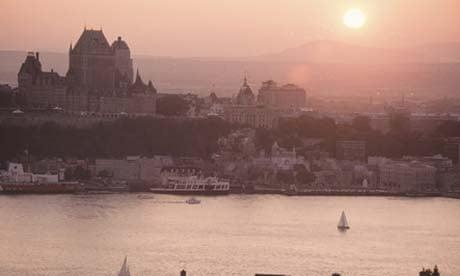
To experience the sudden impact of Quebec City, don't arrive by air or land. Sail up the estuary of the St Lawrence as it narrows between cliffs and rugged hills. Or take the 10-minute ferry ride from the river's southern bank. Either way, you'll understand the site's sheer power.
"Is there any city in the world that stands so nobly as Quebec?" Rupert Brooke asked upon arriving in 1913. "The citadel crowns a headland, 300ft high, that juts boldly out into the St. Lawrence. Up to it, up the side of the hill, clambers the city, houses and steeples … It has the individuality and the pride of a city where great things have happened."
The inhabitants of Quebec City, Brooke added, show "the inexplicable cheerfulness" that marks a foreigner. To him – a young Englishman roving the world at the British Empire's height – the greatest event to have happened here was General Wolfe's triumph over the French in 1759 at the battle of the Plains of Abraham. Those cheerful locals may not have shared his view.
With over 700,000 individuals residing in Quebec, the majority of the population thrives within a French-speaking environment. Serving as the provincial capital, Quebec is officially recognized as a nation within Canada, similarly to Scotland and Wales being nations within the UK. However, the concept of a Québécois nation remains a subject of controversy in various parts of Canada.
This French-infused city offers a rich cultural heritage, attracting countless visitors eager to explore its vibrant streets and iconic landmarks. From quaint cafes serving freshly baked croissants to historic sites like the famous Château Frontenac, Quebec invites you to immerse yourself in its unique blend of European charm and North American allure.

Quebec City holds a significant place in history, as it marks the birth of a city, a province, a nation, and a lost empire, all stemming from Samuel de Champlain's founding in 1608. Although some may perceive Quebec City as merely a few disorganized rows of stone houses near the river, centred on Place Royale, these 17th and 18th-century structures, lovingly restored, serve as a constant reminder of the rich heritage of New France.
However, it is important to recognize that appearances can be deceiving when it comes to Quebec City and its historical landmarks. For instance, we encounter the church of Notre Dame des Victoires, where a busker sets the scene with his melodious tunes of Traditional Fiddle Music of Quebec. Originally built in 1687, this church was initially dedicated to the child Jesus but underwent a transformation after the city successfully withstood two English assaults. Renamed Our Lady of Victories, it unfortunately fell victim to the ravages of battle, sustaining irreparable damage to its walls, roof, glass, and furnishings under Wolfe's fearsome guns.
Discover the fascinating stories embedded within Quebec City's quaint streets and buildings, where each corner reveals complexities and revisions of its past. Immerse yourself in the narratives and woven heritage of this cherished Canadian destination.
Rebuilt in elaborate style, the building as it now exists dates only from the 19th century, when it became the parish church for Irish immigrants fleeing famine and oppression at home. At least a third of all Quebecers are believed to have an Irish ancestor. And if those "traditional" fiddle tunes sound very much like jigs and hornpipes, that's because they are.
In the forested hills around Quebec City, villages named Shannon and Coleraine – and others called Sainte-Brigitte-de Laval and Saint-Patrice-de-Beaurivage – attest to the importance of Irish settlement. But nearly all the villagers now live in French. It's language, rather than ethnicity, that makes Quebec a nation.
From the Rue du Petit Champlain, not far from Place Royale, you can take a funicular ride up to the clifftops, where dozens of restaurants and hotels vie for business within the stone walls of the old city. (Or you can, if you prefer, climb the Escalier du Casse-Cou.) Less than a mile inland stands the provincial legislature – the National Assembly, I mean. One way to reach it is to pass through the imposing Porte St-Louis.
But that gate was built under orders from a British aristocrat, the Marquess of Dufferin, in 1878. Dufferin was governor-general of Canada at the time. Without his efforts, the French walls and much else in Quebec City might have been demolished.
World heritage city
"Quebec is as refreshing," wrote an enthusiastic Rupert Brooke, "after the other cities of this continent as an immortal among a crowd of stockbrokers. She has, indeed, the radiance and repose of an immortal; but she wears her immortality youthfully."
Unesco agreed with him. In 1985 it designated Vieux Québec, the walled city, as a World Heritage Site. The Organization of World Heritage Cities (OWHC) has its headquarters here. The old quarter houses about 7,500 residents, giving it a vibrancy unusual for a tourist haunt.
"Remember," one of the residents told me, "this is the heart of French civilization in America." Yet there's a paradox. The city prides itself on its Gallic flair and European feel. Yet its modern buildings are standard North American – and much of the historic architecture drew its inspiration from Britain.
The Conservatoire d'Art Dramatique, for instance, trains young Quebec actors in a neoclassical edifice on a hilly side street. But it was built in 1824 as Trinity Chapel of Ease. On a nearby street you'll find a research centre of Hôtel-Dieu Hospital in a building that began life as St Patrick's Church. The Anglican cathedral, one of the few in North America to practise the art of change-ringing, was completed in 1804 and modelled on London's St. Martin in the Fields.
Younger areas of the city have improved sharply over the past couple of decades. St Roch, for example, has ceased to be a haven for hookers and motorcycle gangs, and has turned into a neighbourhood awash in commercial and artistic chic. Along with the expensive restos, casual hangouts like La Casbah Pub & Grill provide food in the international language of our age: "burgers, pizzas, pastas, steaks, frites, nachos." This is, bear in mind, a version of French.
Wandering along its thin, sloping streets, where stone and brick buildings press up against the pavement, I realised finally what Quebec City reminds me of. This is a windswept, northerly town, the capital of a minority nation. It has a vibrant arts scene, a fading history of church power, and a troubled relationship with les anglais. In mere numbers, it has been surpassed by an upstart neighbour; but in age and pride, it's unequalled.
Think of it not as a small-scale Paris, but as a trans-Atlantic Edinburgh.
A people's history
"Montrealers sometimes look down on us," Maurice admitted over a bowl of café au lait in the elegant Café Krieghoff. "They think we're provincial or unsophisticated."
Maurice, who is both a scientist and an educator, is annoyed by such aspersions. So are many of his fellow citizens, who rejoice that Quebec City has nurtured such globally renowned artists as Robert Lepage. His latest project, The Image Mill, will receive its premiere here in July: not a theatre piece, the advance publicity suggests, but a huge architectural projection beside Bassin Louise, a neglected chunk of waterfront.
Quebec City, particularly its vanished Chinatown, played a key role in Lepage's earlier work The Dragons' Trilogy. This year he is returning home for the city's 400th anniversary party. The yearlong festivities will span everything from the World Ice Hockey Championship to the International Eucharistic Congress, not to mention performances by Québécois icons like Céline Dion and the Cirque du Soleil.
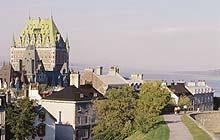
If the city has a signature building, it must be the Château Frontenac, an extravagant Victorian hotel overlooking the St. Lawrence River. Its baronial splendours were supposedly inspired by castles of the Loire; yet the hotel was designed by an American, Bruce Price.
Roosevelt and Churchill met twice at the Château Frontenac in the early 1940s. In tribute to those meetings, busts of the two leaders adorn a park beside the National Assembly. A bust of Mackenzie King, the Canadian prime minister who hosted the events, is nowhere to be found.
The National Assembly grounds – once a cricket pitch for British officers – contain a statue of René Lévesque, the broadcaster-turned-politician who for nearly two decades led Quebec's fight to separate from Canada. He served as premier from 1976 to 1985.
"There is a time," a French-language inscription quotes him as saying, "when courage and quiet audacity become, at key moments of a people's history, the only fitting form of prudence." If a people fails to accept the necessary risk, Lévesque warned, it can miss its vocation forever, "exactly like a man who is afraid of life."
Twice Quebec has voted on whether to split from Canada; twice it has said no (the second time by a hair's breadth). The question has appeared less urgent of late, but it never goes away entirely. Perhaps it never will.
For history infuses daily lives, especially in a place like Quebec City where the past is both celebrated and contested. A narrow road in the St. Jean Baptiste district follows the track down which British soldiers pursued the retreating French army in September 1759. A local militia harassed Wolfe's troops, allowing most of the French to escape. The road has a Scottish name, Chemin Sutherland, that seems at odds with popular memory.
The battlefield itself is now a rolling, grassy park, managed by the government of Canada and containing dozens of explanatory placards in English and French alike. Like Arthur's Seat in Edinburgh, it offers a high space to reflect on the vagaries of history. You realize, looking at the river far below, that Quebec City's story is not just one of victory and defeat, but of tenacious survival.
Prosperity has not taken away the city's romantic edge. Neither has it removed the hard questions that some residents ask themselves each day.
Getting there
Air Canada flies to Quebec City via Toronto from £576 return inc taxes. Or fly via Montreal with Canadian Affair from £198 and take the two-hour train journey with VIA Rail from £40 return. Mark Abley stayed in Auberge le Vincent (+1 888 523 5005), a small inn in the St Roch district that draws on the artwork of Vincent Van Gogh as an inspiration. A room for two, with breakfast, costs between $144 and $194 per night (£74-£96). For a full calendar of events to mark the 400th anniversary, go to myquebec2008.com